
4.2 KiB
Getting Started
Getting the Code
Either clone the repository using Git:
git clone git@github.com:OHIF/Viewers.git
or Download the latest Master as a ZIP File.
Run the OHIF Viewer application against our public DICOM server
You can either spin up locally or run with Docker.
running everything
- Install Node.js
- Open a new terminal tab, go under
ohif-viewerdirectory and install all dependency packages viayarn
cd Packages-react/ohif-viewer
npm install
- Run the application
yar start
Note: This will connect to our public DICOMWeb server so you can verify your installation. Follow the next section to connect to your own local or remote DICOMWeb server.
- Launch the OHIF Viewer Study List. By default the address is http://localhost:3000/. The port may vary so check the start up output messages such as:
Compiled successfully!

You can now view ohif-viewer in the browser.

  Local:            http://localhost:5000/
  On Your Network:  http://10.74.20.83:5000/

Note that the development build is not optimized.
To create a production build, use yarn build.
If everything is working correctly, you should see the studies from our public archive when you visit the Study List.
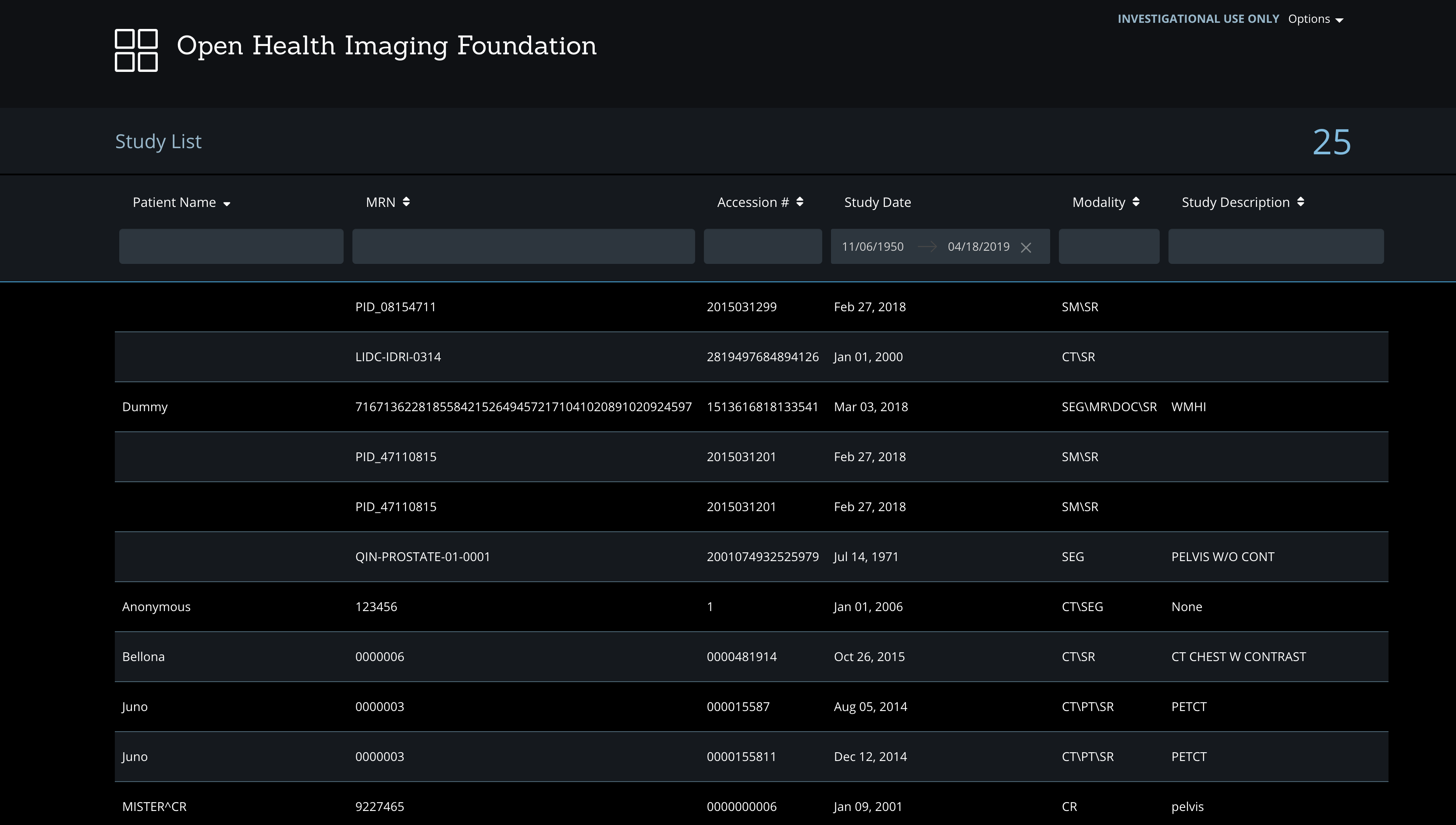
- Double-click on a Study in the Study List to launch it in the Viewer
If everything is working correctly, you should see your study load into the Viewer.
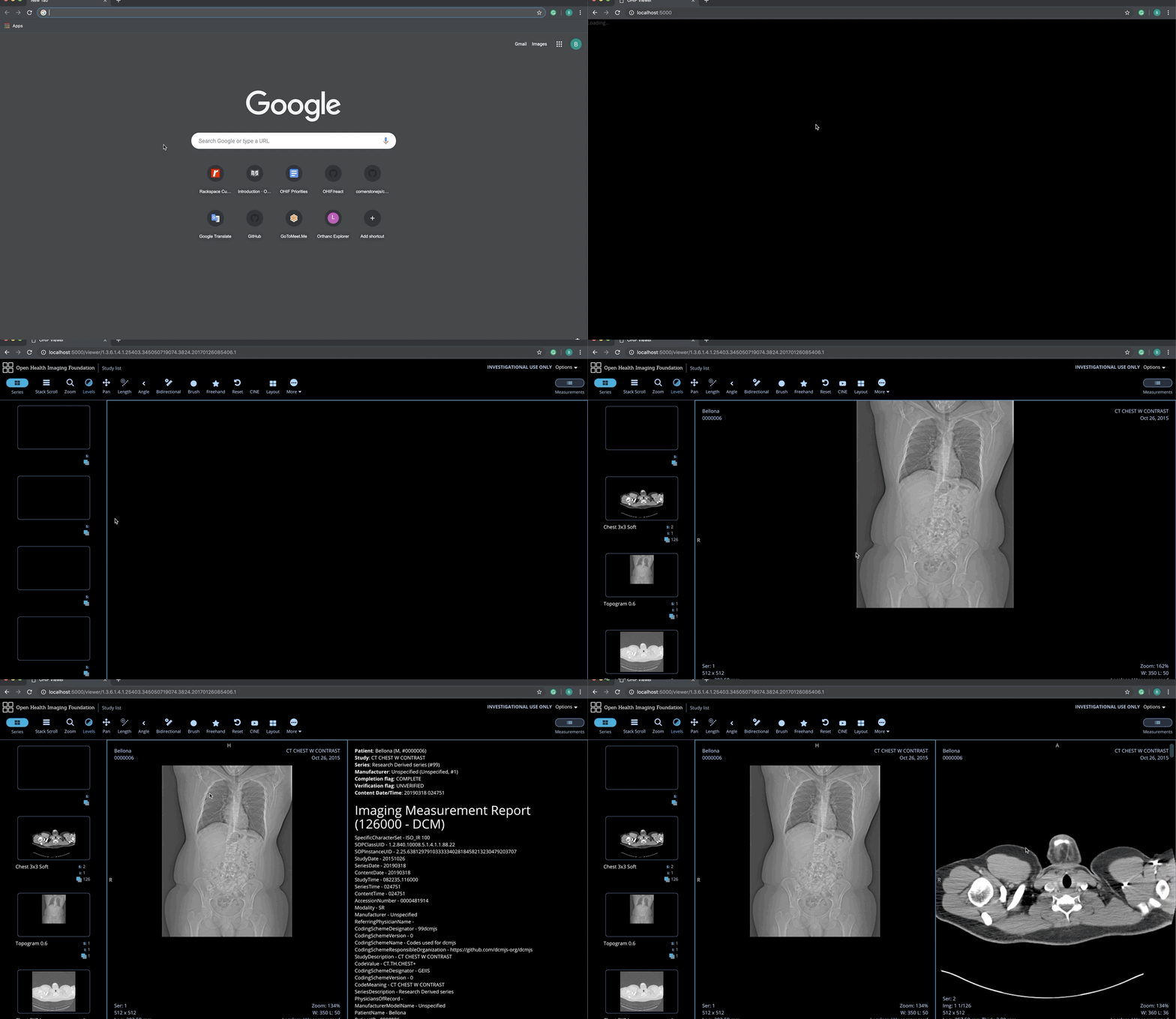
Set up a local DICOM server
- Choose and install an Image Archive
- Upload some data into your archive (e.g. with DCMTK's storescu or your archive's web interface)
- Keep the server running
Open Source DICOM Image Archive Options
Archive | Installation -------------------------------------------| DCM4CHEE Archive 5.x | Installation with Docker Orthanc | Installation with Docker DICOMcloud (DICOM Web only)| Installation OsiriX (Mac OSX only) | Horos (Mac OSX only) |
Feel free to make a Pull Request if you want to add to this list.
Set up and test the OHIF Viewer application:
- Install Node.js
- Open a new terminal tab in the
ohif-viewerdirectory and install all dependency packages via NPM
cd Packages-react/ohif-viewer
npm install
- Run the application using one of the available configuration files.
REACT_APP_CONFIG=$(cat ../../config-react/ccc.json)
npm start
This uses the Custom Environment Variables of Create-React-App to pass in your configuration. The example above will not work on Windows. Please visit the link to read about how to set environment variables on Windows.
- Launch the OHIF Viewer Study List by visiting http://localhost:3000/ in a web browser.
If everything is working correctly, you should see the Study List from your archive when you visit the Study List.
- Double-click on a Study in the Study List to launch it in the Viewer
If everything is working correctly, you should see your study load into the Viewer.
Troubleshooting
- If you receive a "No Studies Found" message and do not see your studies, try changing the Study Date filters to a wider range.
- If you see a 'Loading' message which never resolves, check your browser JavaScript console inside the Developer Tools to identify any errors.
- If you see any errors in your server console, check the Troubleshooting page for more in depth advice.