 bd1c38c00c
* feat: cs3d working stack viewport and tools (#19)

* Squashed everything

* fix weird react issue

* fix eslint / prettier stuff

* thumbnails work now with cpu rendering

* feat: use new loadImageToCanvas in cs3d

* make jump to measurement work

* fix active thumbnail

* fix measurement delete

* fix window level presets

* remove segmentation and sync groups for now

* fix the dicom pdf and dicom video

* fix cornerstone window assignment for cypress

* apply review comments

Co-authored-by: Erik <erik.sweed@gmail.com>

* feat: cs3d tools and toolGroups (#20)

* add more tools to work with cs3d mode

* fix hotkeys

* add stack manager usage for stach viewports

* add image scrollbar

* wip viewport overlay

* fix toAnnotation schema for tools

* fix the unnecessary size change that triggered resize

* hanging protocol improvement to allow unmatched errors

* study description matching for hanging protocol

* fix the displaysetOptions to work

* fix handle the active tool when a new viewport is added

* fix separate toolGroups for mode

* apply review comments

* apply review comments

* yarn lock

* feat: overlay component (#21)

* fix default displayset options

* add viewport overlay

* apply review comments

* feat: loading and orientation indicators (#22)

* add loading indicator

* add orientation marker initial work

* apply review comments

* fix: orientation markers (#23)

* finished the orientation markers

* fix various broken cypress tests

* apply review comments

* update yarn lock

* feat: re-working measurement tracking mode with cornerstone3d (#2805)

* feat: cs3d working stack viewport and tools (#19)

* Squashed everything

* fix weird react issue

* fix eslint / prettier stuff

* thumbnails work now with cpu rendering

* feat: use new loadImageToCanvas in cs3d

* make jump to measurement work

* fix active thumbnail

* fix measurement delete

* fix window level presets

* remove segmentation and sync groups for now

* fix the dicom pdf and dicom video

* fix cornerstone window assignment for cypress

* apply review comments

Co-authored-by: Erik <erik.sweed@gmail.com>

* feat: Add Measurement tracking mode with cs3D (#2789)

* feat: first render for cornerstone3d tracked viewport

* make tool active work

* wip for SR extension

* renamed dicom sr to cornerstone dicom sr

* remove cornerstone from dicom pdf and video

* move dicom sr logic to sr extension

* feat: Add hydration for the length tool

* fix SR display tool for length using cs3d

* fix default config

* fix: various bugs with sr viewport and tracking

* fix promptying to continue tracking for when SR is created

* feat: add keep trackign of unique identifiers

* fix hydration for same imageIds

* feat: Add SR toolGroup creation on modeEnter

* feat: remove the need for separate mapper for SR hydration

* add SR display for ellipse

* handle hydration of elliptical ROI tool

* remove cornerstone extension

* add arrow mapping

* feat: Add ArrowAnnotate SR display and hydration

* apply review comments

* apply review comments

* move viewport labels to the viewportData

* apply review comments

* fix: integration cypress tests with cornerstone3D and add CINE tool (#2795)

* fix: integration cypress tests with cornerstone3D

* revert to addOrUpdate as it makes more sense

* fix local drag and drop

* fix tests

* move dicomLoaderService to cornerstone extension

* fix various import bugs

* fix bug for local PT series

* fix various unit tests

* bump cs3d versions

* add angle and magnify tool

* bump dependencies to avoid broken peerDeps

* feat: add initial work for capture using cs3d

* feat: show annotations on the image capture

* feat: add svg layer export

* feat: Add CINE Tool

* feat: remove unnecessary viewport rendering for cine state changes

Co-authored-by: Erik Ziegler <erik.sweed@gmail.com>

* docs: modify and improve documentation (#2800)

* cleanup docs versionings

* feat: Add all version explanations

* version docs for 3.0

* wip for changing docs

* wip for updated docs

* add utility module documentation

* fix demo with nohoisting of history

* add slides and video to resources

* apply review comments

* fix: drag and drop SR into SR viewport (#2803)

* update yarn lock

Co-authored-by: Erik <erik.sweed@gmail.com>

* update pathnames to match v3-stable

* update the e2e pathname

* fix: various bugs with regard to tracking workflow (#2811)

* fix: various issues with measurement panel

* fix: update default tool style for annotations

* fix: annotatoin label getting removed

* feat: Add backward compatibility for SR hydration with legacy cornerstone

* fix: cursors and ellipse ROI max style

* fix: ArrowAnnotate SRDisplay

* apply review comments

* bump package versions

* fix: bugin rehydration of SR

* fix: e2e tests

* fix active viewport thickness and arrowTool ui

* add readme for measurement tracking

* use uploaded image for readme

* add back images

* try to fix e2e test

* fix: window level presets hotkeys

* Update README.md

* update yarn lock

* feat: volume api and TMTV mode (#2817)

* feat: volumeAPI and TMTV mode

* feat: use cs3d cache service to obtain viewportData

* wip for volume api

* wip: fusion viewport

* feat: add blend mode option

* wip for image scrollbar

* fix drag and drop thumbnail

* wip for image scrollbar for voluems

* fix: element mismatch bug for scroll

* feat: Add image scrollbar to volumes

* feat: add syncGroups to volume api

* feat: add tmtv mode initial setup

* feat: add initial image options for the stack viewports

* feat: Add custom load strategy for volume viewports via HP

* apply review comments

fix: Jump presets cs3d (#2812)

* feat: Add JumpPreset to OHIF for Cornerstone3D

* fix: accessing viewport service from servicesManager

feat: volume API and TMTV mode (#2814)

* fix: do not display overlays on mip viewports

* feat: add optional disableCommands for toggle buttons

* fix: toggleCrossharis

* feat: config the crosshairs

* feat: add PetSUV Panel for changing metadata

* feat: initial work for the rectangleROIThreshold panel

* wip: measurement service

* roi threshold working

* feat: Add displayText to segmentations

* feat: add remove segmentation

* feat: add csv export

* feat: add RT export for annotations in tmtv mode

* fix: fusion to use pt in tmtv mode and measuremet mappings

* fix: various bugs

* apply review comments

* apply review comments

* feat: add fusion color maps

* add readme to tmtv mode

* Update README.md

* fix: try to fix build

* fix unit tests

* Update README.md

* feat: add about to the panel

* fix: changing strategy in roi panel

* apply review comments

* update package versions

* wip for stackPrefetch

* fix: cornerstone3d hydration and renaming (#2818)

* update readme

* renamed cornerstone extension

* wip for renaming cornerstone3D variables

* wip for renaming cornerstone3D variables

* wip for fixing bugs for SR viewport

* fix: jumpToMeasurement and initial label after hydration

* fix: fileName capitalization

* feat: use the new prefetch stack in the cs3d (#2820)

* feat: use the new prefetch stack in the cs3d

* use viewport scroll api for stack viewport

* fix cine stop when scrollbar changes

* feat: use new prefetch events

* fix loading state to not show repeatedly

* fix: various bugs for tmtv mode thresholding and new icons (#2823)

* feat: make tmtv mode available in worklist

* feat: add new icons for tmtv mode

* feat: add fusion color icon

* fix: parallel scale calculation

* fix: bump Cornerstone to get large image support working

* fix: Fix issues with CPU viewport flipping, including config files

* fix: bump cornerstone to fix magnify tool

* fix: Bump Cornerstone version to fix resetCamera issue in StackViewport

* ci: Add _headers file to enable CORS headers for Netlify Drag/Drop deploys

* fix: WADO-URI was not working. PET Metadata was coming from the wrong place. Fixed some minor React errors

* feat(OHIF):Allow modes and extensions to be added after commpile time. (#2838)

Also works with the compile time add that the existing cli uses, so that both build types work.
Eric and I agreed this doesn't change existing functionality, but is almost entirely build issues/fixes.

* bump: dependency versions to fix hydration bugs (#2848)

* bump: dcmjs version to fix hydration bugs

* try to fix tests

* bump dependency versions

Co-authored-by: Alireza <ar.sedghi@gmail.com>
Co-authored-by: Bill Wallace <wayfarer3130@gmail.com>
8.3 KiB
| sidebar_position | sidebar_label |
|---|---|
| 2 | Architecture |
Architecture
In order to achieve a platform that can support various workflows and be extensible for the foreseeable future we went through extensive planning of possible use cases and decided to significantly change and improve the architecture.
Below, we aim to demystify that complexity by providing insight into how
OHIF Platform is architected, and the role each of its dependent libraries
plays.
Overview
The OHIF Medical Image Viewing Platform is maintained as a
monorepo. This means that this repository, instead of containing a
single project, contains many projects. If you explore our project structure,
you'll see the following:
│
├── extensions
│   ├── _example             # Skeleton of example extension
│   ├── default              # default functionalities
│   ├── cornerstone          # 2D images w/ Cornerstone.js
│   ├── measurement-tracking # measurement tracking
│   ├── dicom-sr             # Structured reports
│   └── dicom-pdf            # View DICOM wrapped PDFs in viewport
│
├── modes
│   └── longitudinal         # longitudinal measurement tracking mode
│
├── platform
│   ├── core                 # Business Logic
│   ├── i18n                 # Internationalization Support
│   ├── ui                   # React component library
│   └── viewer               # Connects platform and extension projects
│
├── ...                      # misc. shared configuration
├── lerna.json               # MonoRepo (Lerna) settings
├── package.json             # Shared devDependencies and commands
└── README.md
OHIF v3 is composed of the following components, described in detail in further sections:
@ohif/viewer: The core framework that controls extension registration, mode composition and routing.@ohif/core: A library of useful and reusable medical imaging functionality for the web.@ohif/ui: A library of reusable components to build OHIF-styled applications with.Extensions: A set of building blocks for building applications. The OHIF org maintains a few core libraries.Modes: Configuration objects that tell @ohif/viewer how to compose extensions to build applications on different routes of the platform.
Extensions
The extensions directory contains many packages that provide essential
functionalities such as rendering, study/series browsers, measurement tracking
that modes can consume to enable a certain workflow. Extensions have had their
behavior changed in OHIF-v3 and their api is expanded. In summary:
In
OHIF-v3, extensions no longer automatically hook themselves to the app. Now, registering an extension makes its component available tomodesthat wish to use them. Basically, extensions inOHIF-v3are building blocks for building applications.
OHIF team maintains several high value and commonly used functionalities in its
own extensions. For a list of extensions maintained by OHIF,
check out this helpful table.
As an example default extension provides a default viewer layout, a
study/series browser and a datasource that maps to a DICOMWeb compliant backend.
Click here to read more about extensions!
Modes
The modes directory contains workflows that can be registered with OHIF within
certain routes. The mode will get used once the user opens the viewer on the
registered route.
OHIF extensions were designed to provide certain core functionalities for
building your viewer. However, often in medical imaging we face a specific use
case in which we are using some core functionalities, adding our specific UI,
and use it in our workflows. Previously, to achieve this you had to create an
extension to add have such feature. OHIF-v3 introduces Modes to enable
building such workflows by re-using the core functionalities from the
extensions.
Some common workflows may include:
- Measurement tracking for lesions
- Segmentation of brain abnormalities
- AI probe mode for detecting prostate cancer
In the mentioned modes above, they will share the same core rendering module
that the default extension provides. However, segmentation mode will require
segmentation tools which is not needed for the other two. As you can see, modes
are a layer on top of extensions, that you can configure in order to achieve
certain workflows.
To summarize the difference between extensions and modes in OHIF-v3 and
extensions in OHIF-v2
Modesare configuration objects that tell @ohif/viewer how to compose extensions to build applications on different routes of the platform.- In v2 extensions are “plugins” that add functionality to a core viewer.
- In v3 extensions are building blocks that a mode uses to build an entire viewer layout.
Click here to read more about modes!
Platform
@ohif/viewer
This library is the core library which consumes modes and extensions and builds an application. Extensions can be passed in as app configuration and will be consumed and initialized at the appropriate time by the application. Upon initialization the viewer will consume extensions and modes and build up the route desired, these can then be accessed via the study list, or directly via url parameters.
Upon release modes will also be plugged into the app via configuration, but this is still an area which is under development/discussion, and they are currently pulled from the window in beta.
Future ideas for this framework involve only adding modes and fetching the required extension versions at either runtime or build time, but this decision is still up for discussion.
@ohif/core
OHIF core is a carefully maintained and tested set of web-based medical imaging functions and classes. This library includes managers and services used from within the viewer app.
OHIF core is largely similar to the @ohif/core library in v2, however a lot of logic has been moved to extensions: however all logic about DICOMWeb and other data fetching mechanisms have been pulled out, as these now live in extensions, described later.
@ohif/ui
Firstly, a large time-consumer/barrier for entry we discovered was building new UI in a timely manner that fit OHIF’s theme. For this reason we have built a new UI component library which contains all the components one needs to build their own viewer.
These components are presentational only, so you can reuse them with whatever logic you desire. As the components are presentational, you may swap out @ohif/ui for a custom UI library with conforming API if you wish to white label the viewer. The UI library is here to make development easier and quicker, but it is not mandatory for extension components to use.
Check out our component library!
Overview of the architecture
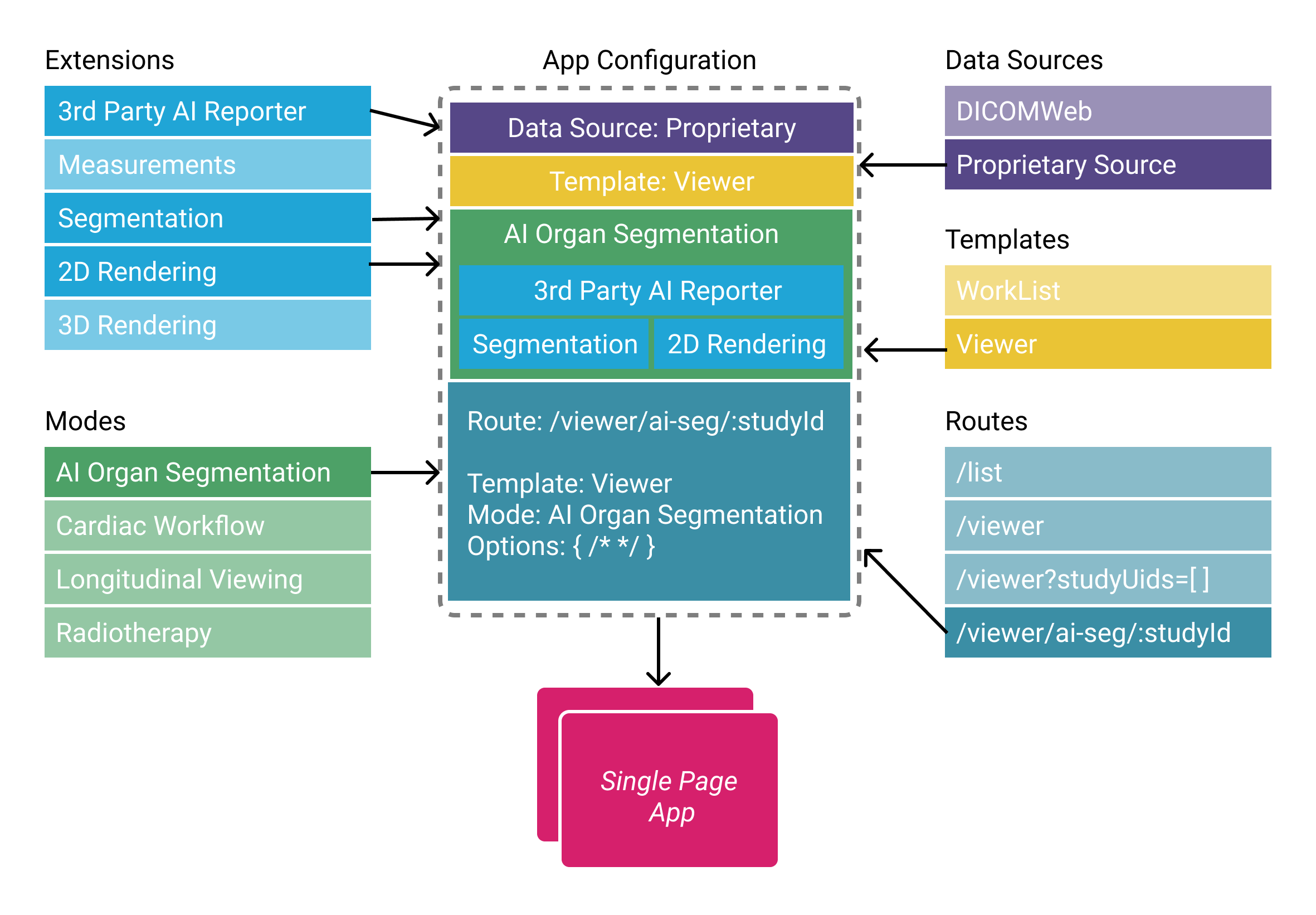
OHIF-v3 architecture can be seen in the following figure. We will explore each piece in more detail.
Common Questions
Can I create my own Viewer using Vue.js or Angular.js?
You can, but you will not be able to leverage as much of the existing code and
components. @ohif/core could still be used for business logic, and to provide
a model for extensions. @ohif/ui would then become a guide for the components
you would need to recreate.
When I want to implement a functionality, should it be in the mode or in an extension?
This is a great question. Modes are designed to consume extensions, so you should implement your functionality in one of the modules of your new extension, and let the mode consume it. This way, in the future, if you needed another mode that utilizes the same functionality, you can easily hook the extension to the new mode as well.